The Loadshedding Shape
THIS IS A WORK OF FICTION
At 8:17 p.m., during the loadshedding, my neighbor’s wife climbed down the wall headfirst and asked if we had any mustard oil.
Not fell.
Not slipped.
Climbed.
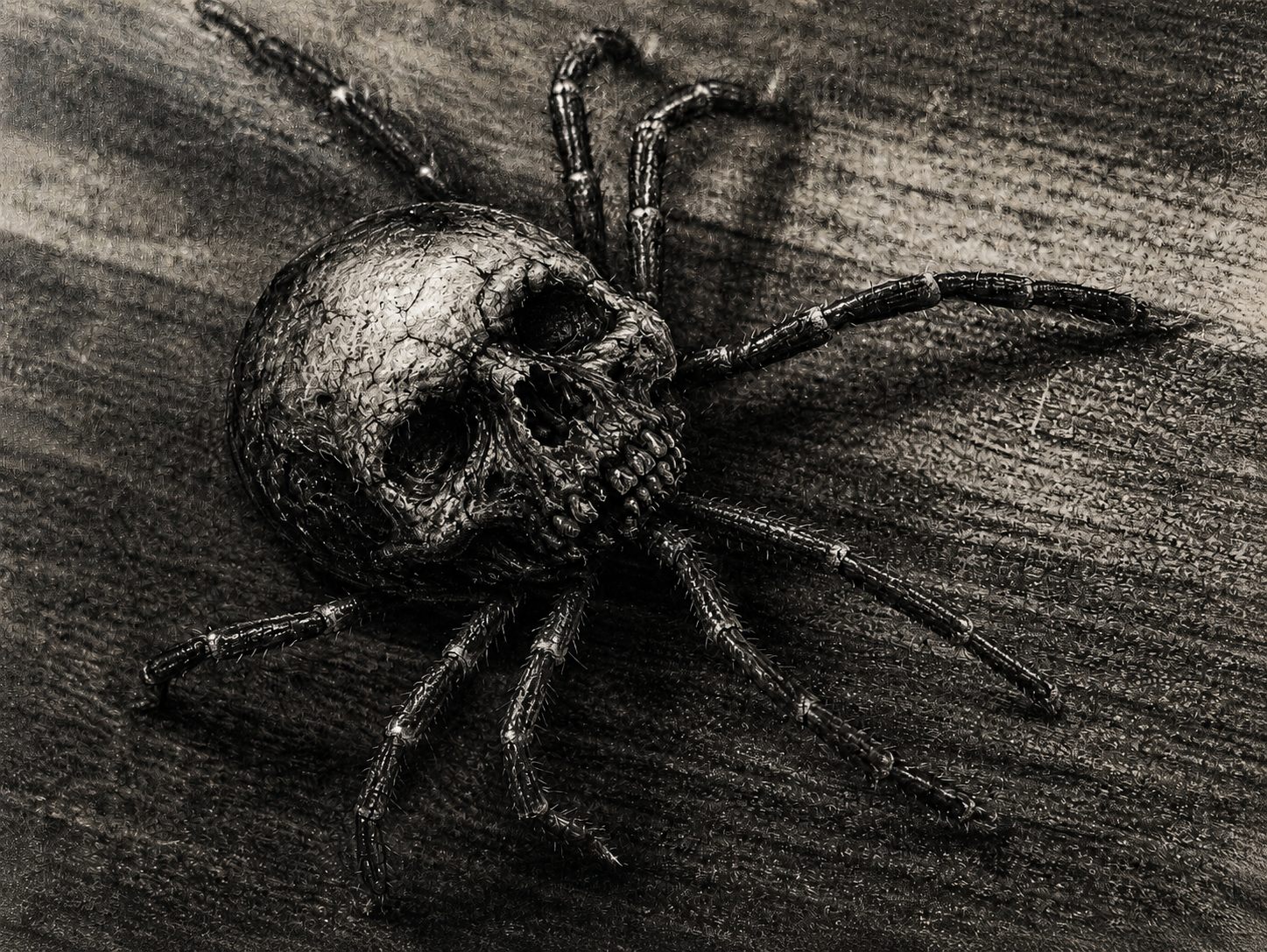
She came down the damp brick wall of our Cossipore lane like a large black beetle wearing an old woman’s skull for a helmet, six jointed legs ticking against the mossy plaster. Her sari was gone. Her bangles had become pale rings around two front legs. Her hair was a wet brush of feelers.
“Dada,” she said, in Bina-di’s exact tired voice, “only two spoons. The fish is already salted.”
I was standing in my doorway with a matchbox in one hand and my mother’s emergency battery fan in the other. The whole para had gone dark ten seconds earlier. The ceiling fan had stopped with the usual dying click. From every flat came the normal sounds of Calcutta power failure: groans, abuse, plastic chairs scraping, someone shouting for a candle, a baby complaining to the universe.
Then the shouting changed.
Not louder.
Lower.
It became a dry rustle. Like many people trying to whisper through nutshells.
Behind me, Ma said, “Who is it?”
I did not answer.
Bina-di turned her skull-shaped head toward the sound. She had eye sockets now. Not eyes. Two wet black pits shining in the faint orange light from a kerosene stove across the lane.
“Masima is home?” she asked politely.
“Yes,” I said.
“Good. Old people should not go out in this condition.”
“What condition?”
She leaned closer.
Her mouth was a crowded little trap of moving parts. Something small and pink trembled inside it, trying to remember lips.
“You have not looked at yourself yet,” she said.
I shut the door on her face.
The latch did not catch because one of my fingers had split into three thin hooks.
For a while I stood very still.
This is a foolish thing people say about fear: that it makes you scream. Sometimes it makes you tidy. I placed the matchbox carefully on the table. I adjusted the battery fan so it faced Ma’s bed. I took one step toward the mirror near the Godrej almirah and stopped because the floor felt wrong.
Not under my feet.
Under all of me.
My weight had gone sideways. My body wanted the wall.
“Why are you scratching?” Ma asked from the bed.
“I am not.”
“You are. Like a rat inside a biscuit tin.”
She was eighty-two and half-blind after cataract surgery that had been postponed three times because the surgeon’s assistant kept discovering new charges, like a magician pulling invoices from a pigeon. She had a bad chest, worse knees, and the moral authority of a retired headmistress who could make even mosquitoes feel undereducated.
The battery fan whirred weakly.
Outside, the lane continued to reorganize itself.
Someone laughed. It came out as a clicking shower of seeds.
Someone else cried, “My legs! My legs!”
A man answered, “At least now you have enough.”
Then a crash. A pressure cooker lid rolled down the lane in the dark, ringing against the drain covers.
Ma said, “Partha, light the candle.”
I looked at my hand.
It was not a hand.
It was a black hooked thing, glossy and jointed, ending in little bone-colored claws. I lifted the other one. Same. My forearms had thinned and hardened. They made a quiet wooden sound when they touched.
“Partha?”
“Yes.”
“Candle.”
“I am trying.”
“You always try as if trying is a government department.”
The candle was in the steel tumbler near the calendar. I picked it up on the third attempt, snapping the wick off on the first. The matchbox was worse. Each match broke in my new pincers. Sulfur dust smeared the table.
In the dark glass of the almirah, I saw something move.
Human-sized.
Low.
A black armored belly. Six legs. A round skull-head too large for its body, dented like old plaster, with nose holes and sockets and a grin made of tiny hinged plates.
It was wearing my voice.
I made a sound.
Ma said, “Don’t make drama. Candle first, then drama.”
Outside, Bina-di tapped politely on our door.
“Dada? Mustard oil?”
I wanted one ordinary thing: to get Ma through the loadshedding. One hour, maybe two. Keep the fan on her. Keep her breathing calm. Keep the mosquitoes off. Keep the lane outside. Keep the world at the door.
Small wish.
A spoon in a flood.
I managed to light the candle on the ninth match by trapping it between two claws and scraping like a convict sharpening a nail. The flame jumped up.
Ma looked at me.
I waited for her to scream.
She squinted.
“Why are you standing like that?”
“Like what?”
“Like your father when he had gas.”
Then the candlelight reached her properly.
Her face did not change in fear. It changed in annoyance.
“Oh,” she said.
That was all.
Oh.
As if I had come home with a bad haircut.
I turned the candle toward her and saw why.
Ma had become one too.
Smaller. Frailer. A skull-shelled creature tucked under her faded sheet, six legs folded close to her body like umbrellas. Her white hair had become a soft fringe of antennae. The big vein on her forehead was still there somehow, blue under bone.
She lifted one front leg, looked at it, and said, “This will make holding a cup difficult.”
Then she coughed.
Same cough.
Wet. Deep. Familiar as unpaid bills.
I brought the fan closer.
In the lane, the first great argument began.
It was, naturally, about parking.
Before the change, the main conflict in our lane had been between a scooter, a fruit cart, and the philosophical question of how much public space one man could claim with a broken plastic chair. Now the scooter owner, who had become a long black skull-crawler with two gold rings fused into his feelers, was shouting at the fruit seller, also transformed, because the fruit cart had overturned and mangoes were rolling in the drain.
“You scratched my Activa!”
“You are walking on the ceiling, Haru! Why do you need Activa?”
“Sentiment!”
“Sentiment my backside! You ate two langra mangoes with your back leg!”
“I did not eat. It entered.”
“Everything enters you people. Money enters, manners leave.”
The lane clicked and hissed with approval.
A child scuttled across our window grill upside down, giggling.
His mother screamed, “Come down!”
“I can see the whole para!”
“Come down before your father sees you enjoying anything!”
I should have been horrified. I was horrified. But horror in Calcutta must stand in line behind practical inconvenience. Ma needed water. The candle was melting too fast. The fan battery had three weak lights, two of them dead. I had no idea whether our new bodies needed medicine, food, prayer, pesticide, or a municipal certificate.
The phone rang.
I had left it charging when the power went out. It glowed on the table like a tiny, smug planet.
Unknown number.
I touched the screen with one claw and answered by mistake.
A man’s voice said, “Dear consumer, this is an automated call from North Suburban Electric Supply. Due to technical reasons, power restoration in your area may be delayed. Please remain indoors. Do not panic. Do not attempt to prove human identity until supply resumes.”
The line clicked.
Then a second voice came on.
Not recorded.
Soft. Close.
“Consumer number?”
I said nothing.
The voice repeated, “Consumer number?”
I looked at the bill stuck under the glass top of the table. The bill had my name, meter number, arrears, and a red stamp threatening disconnection with the enthusiasm of a small king.
“Who is this?” I asked.
A pause.
“Verification.”
“For what?”
“To decide whether your lane comes back as before.”
My mouthparts moved against each other. They made a dry chewing sound.
“Before what?”
But the call had ended.
Bina-di tapped again.
Not with knuckles.
With six little points.
“Dada, oil? Also, if you have any newspaper, my husband is stuck in the bathroom.”
I opened the door one inch.
She was clinging to the outer wall. Behind her, the lane had become a terrible domestic festival. Skull-crawlies moved over balconies, drains, window bars, water pipes, each one carrying some piece of former life. A schoolbag. A pressure cooker. A plastic mug. A packet of incense sticks. A half-eaten roti pinched delicately between mandibles.
The smell had changed too. The usual hot Calcutta mix of drain water, frying fish, dust, and human worry now had an extra odor: old coins and wet shells.
“What happened?” I asked.
Bina-di leaned closer. In candlelight her skull-head shone like burnt coconut.
“Power went.”
“I know power went.”
“No,” she said. “Power went from us.”
Below her, her husband tried to squeeze his new body out through their bathroom window. He had been a broad, sleepy man with diabetes and a talent for losing lottery tickets. Now he was a skull with legs and a towel somehow wrapped around his middle.
“Bina!” he shouted. “I am not stuck. The architecture is stuck.”
“You see?” Bina-di said. “Men.”
I gave her mustard oil in a small bowl. She took it with two hooked legs and climbed away sideways.
“Lock your door,” she called back. “The club boys are checking who changed properly.”
This was worse than the insects.
The club boys.
Every para has them. Young men who have no job but possess chairs, whistles, political flags, and opinions about other people’s balconies. In normal times they collect puja subscriptions. In bad times they become government. In worse times they become God with a receipt book.
I shut the door.
Too late.
A voice rose outside.
“Everyone come to the lane! Verification!”
Another voice: “Bring Aadhaar!”
A third: “Aadhaar photo is human, idiot!”
“Then bring electricity bill!”
This caused immediate respect.
Even transformed into crawling skulls, we understood the sacred terror of paperwork.
Ma said, “Don’t go.”
“I have to see.”
“You never have to see. Seeing is how trouble enters educated men.”
“I got a call.”
“From whom?”
“Electricity office.”
Ma was silent.
That frightened me more than anything.
In our family, silence after mention of a utility office meant the gods had left the country.
“What did they say?” she asked.
“They asked for consumer number.”
“Did you give?”
“No.”
She made a clicking noise that might have been relief.
“Good.”
“Why?”
From outside came the sound of many legs gathering.
Ma turned her skull-face toward the window.
“Your father gave once.”
My father had been dead seventeen years.
He died on a hot afternoon, during a power cut, while trying to fix a table fan with a screwdriver and the confidence of a Bengali man who had read half the manual in 1983. Heart attack, they said. Bad luck, they said. Heat, age, stress, all the usual small clerks of death.
“What do you mean he gave once?”
Ma’s antennae trembled.
“After the big loadshedding. The one in 1996. Your father got the same call. He thought it was meter reading. He gave the number. Then he forgot.”
“Forgot what?”
“That he had changed.”
Outside, the club boys banged on our shutter.
“Open! Para verification!”
Ma whispered, “Do not let them see you are asking questions.”
That was my first clear terror.
Not that we had become monsters.
That everyone else seemed to know the rules.
I opened the door because cowardice in a crowded lane is difficult. Also the latch was now useless. My claws had already scratched half the wood away.
Three club boys stood outside, each a large skull-crawlie with party-colored ribbons tied around their front legs. They carried candles fixed to bamboo sticks. Behind them, people lined the lane walls, ceiling pipes, balcony grills. The old, the young, the respectable, the useless. All skulls. All legs. All talking.
The leader was Bablu, who in human form wore sunglasses on his head at night.
Now his skull had a crack shaped like lightning above one socket.
“Name?” he asked.
“You know my name.”
“Procedure.”
“Partha Sen.”
“Flat?”
“Ground floor.”
“Consumer number?”
The lane quieted.
Even the children stopped climbing.
I felt Ma behind me, hidden in the dark.
“I don’t remember,” I said.
Bablu’s mandibles clicked.
“Educated man does not remember electricity number?”
“Educated men forget important things. That is our main skill.”
A few people laughed. Too loudly. Relief laughter. Permission laughter.
Bablu did not.
“Show bill.”
“Inside.”
“Bring.”
I turned.
Ma had already moved.
This is a strange sentence to write: my eighty-two-year-old mother ran up the wall.
She went from bed to wall to ceiling with a speed that made the sheet drop behind her like a shed skin. Her six legs clicked across the plaster. She reached the table, hooked the electricity bill, and pushed it under the almirah.
Bablu saw.
His voice changed.
“Masima, why hiding?”
Ma clung upside down above the calendar, small and furious.
“Because you were a nuisance as a human and have not improved with legs.”
Someone said, “True.”
Bablu swung his candle pole toward her.
The flame showed the ceiling in detail. Damp patches. Lizard eggs. Old cobwebs. Ma’s skull-face. My mother, who once slapped a bus conductor for touching a schoolgirl and then spent the evening making posto because morality must not interfere with dinner.
Bablu said, “Those without number will remain.”
“Remain what?” I asked.
He turned to me.
“As is.”
The lane made that rustling whisper again.
A voice from the crowd said, “Some prefer it.”
Another said, “At least knees don’t hurt.”
A third, older voice: “No rent agreement needed if you can sleep on walls.”
Then laughter.
Not happy laughter.
The kind that comes when people see a ditch and call it a shortcut.
The phone rang again inside.
Everyone heard it.
The sound was thin and ridiculous.
Bablu said, “Answer on speaker.”
“No.”
He stepped forward.
I do not know whether courage arrived or whether my new body simply had different instincts. One moment I was blocking the doorway badly. The next I had climbed onto the doorframe above him, all six legs gripping wood, my skull-head inches from his cracked one.
He smelled of paan, sweat, and shellac.
“Move,” I said.
Bablu looked up.
For the first time in fifteen years, a club boy looked uncertain in his own lane.
Then Ma dropped from the ceiling onto his back.
She was small, old, and armed with rage older than his entire political education. Her front claws hooked into the ribbon on his leg.
“Run,” she told me.
I ran.
Not out.
In.
I scrambled across the floor, under the table, clawed out the bill from beneath the almirah, and reached the phone as it began its final ring.
I answered.
This time I said, “Who are you?”
The soft voice said, “Restoration desk.”
“What is happening to us?”
“Temporary disclosure.”
“Disclosure of what?”
“What the load carries.”
Behind me, Bablu shouted. People surged at the door. Ma cursed with the precision of a woman sorting lentils.
The voice continued, calm as a bank form.
“Consumer number.”
“No.”
“Then your section may remain in natural state.”
“Natural?”
A pause. Paper shuffled. Or wings.
“Human presentation is grid-assisted. You have been informed.”
I almost laughed.
Not because it was funny.
Because it was too much like every office answer in the city. A calamity wrapped in passive voice. A civilization ending with “you have been informed.”
“Why only our lane?” I asked.
“Non-payment cluster, unauthorized tapping, meter bypass, political shielding, transformer leakage, ritual overload during festivals, illegal AC line from sweet shop, and accumulated ancestral concealment.”
“Ancestral what?”
“You are exceeding query limits.”
“My father gave the number in 1996.”
“Yes.”
“What happened to him?”
“He requested permanent human billing.”
“He died.”
“Yes.”
The word sat there.
Yes.
Like a stamp.
The crowd pushed into the room.
Bablu first, dragging Ma off his back. Bina-di behind him, bowl of oil still hooked in one leg. Haru, the fruit seller, two children, one retired postmaster, one tutor, one drunk, and half the lane. Their skulls filled the doorway, candlelight sliding over all those bone-faces.
The phone voice said, “Consumer number.”
Bablu hissed, “Give it.”
Someone else said, “Give and finish.”
Another: “Power will come.”
Another: “I have office tomorrow.”
A woman cried, “My daughter has online class!”
Bina-di whispered, “Dada, please.”
I looked at them.
All my life I had thought people were hiding their worst selves. Their greed, envy, smallness, vanity, hunger, fear. The usual household insects of the soul. But this was different. These faces were not worse than human faces. In some awful way they were more honest. A skull cannot pretend beauty. A shell cannot blush. A mandible cannot smile politely while calculating your downfall.
And still they wanted the old faces back.
Of course they did.
A face is a passport.
Without it, no one lets you into the bank, the marriage market, the polling booth, the family photograph, the hospital bed where nurses decide how quickly to come.
Ma crawled down from Bablu’s grip and came beside me.
Her skull touched my leg.
Not affection. Balance.
“Give it if you want,” she said.
“What happens if I don’t?”
“We find out.”
The phone voice said, “Final prompt.”
The fan behind us gave a weak cough and died.
Ma’s breathing changed at once.
Small ordinary thing.
Get Ma through the loadshedding.
That was all I had wanted.
The lane waited.
I looked at the bill.
Consumer number: 0318 77 44921.
Numbers are funny. They feel innocent. Little hooks for giant nets.
I said into the phone, “0318.”
The lane exhaled.
Then I stopped.
The soft voice waited.
Bablu said, “Full number, you donkey.”
I looked at Ma. Her chest worked hard under its new shell. Her antennae moved slowly, tired brushes in dirty air.
“What if human was the illness?” I asked.
Bablu struck me across the head.
The room flashed white.
Not metaphorically. My skull rang like a bowl. I tasted iron, though I no longer had a tongue for tasting.
The phone fell. Someone caught it. Many legs clicked on the floor. The bill tore.
And then the lights came back.
Every tube light in the lane flickered on with a municipal buzz.
For one second, nobody moved.
Then the screaming began properly.
Because the light did not change us back.
It showed us.
In full.
Every flat, every balcony, every stairwell, every kitchen with half-cooked fish and open spice tins, every bed, every calendar, every cheap plastic flower in every dusty vase—filled with skull-headed, human-sized crawling things blinking in white light.
On the television in Haru’s room, which had switched on with the power, the newsreader smiled her perfect human smile and said, “Minor outage reported in parts of North Kolkata. Supply restored. No abnormalities.”
Her face held.
The studio lights held.
The country held.
Only our lane had failed to become presentable.
The phone, lying under a chair, spoke on speaker.
“Partial number received. Restoration incomplete. Your cluster has been classified as mixed.”
Bablu lunged for it.
Ma got there first.
She smashed the phone with one front leg.
Silence rushed in, thick and hot.
Then, from outside the lane, a human voice called, “Current eshe geche?”
Power’s back?
It was the tea stall boy from the main road, peeping into our narrow entrance. He stood under the streetlight, thin, human, holding a kettle. He looked at us.
We looked at him.
His mouth opened.
Before he could scream, Bina-di climbed down from the wall, bowl of mustard oil still in her claws.
“Come,” she said gently, in the voice of every neighbor who has ever borrowed something and never returned it. “Don’t stand there. Mosquitoes will bite.”
The boy stepped back.
Behind him the main road shone with headlights, buses, people, shops, all the old human arrangements. Our lane lay open to it like a crack in a wall.
Then Ma did something I did not expect.
She laughed.
It came out dry and clicking, but it was laughter.
“What?” I asked.
She pointed at the electricity bill, torn in three pieces on the floor.
“Your father,” she said, “always said this house had bad wiring.”
Outside, the tea stall boy ran.
No one chased him.
We were all too busy looking past him, toward the main road, where thousands of human faces moved through the electric light, each one smooth, temporary, and billed monthly.
Above us, the transformer hummed.
Under that hum came another sound, softer and larger.
The whole city, scratching inside its skin.